by Stephanie Watkins-Cruz
Released annually, The Gap: A Shortage of Affordable Homes investigates the affordability and availability of rental homes for households of different income levels nationwide and in every state and major metropolitan area. The 2026 Gap Report by the National Low Income Housing Coalition (NLIHC) finds a national shortage of 7.2 million affordable and available rental homes for extremely low-income renter households–those with incomes at or below the poverty level or 30% of their area median income, whichever is greater.
“The findings from The Gap show that no state or major metropolitan area has an adequate supply of affordable and available homes for extremely low-income renters,” said NLIHC President and CEO Renee M. Willis. “It is a sad fact that only one in four households who qualify for housing assistance receive it. When renters are housing cost-burdened, they cannot afford to cover other basic necessities such as food, healthcare, transportation, or childcare.”
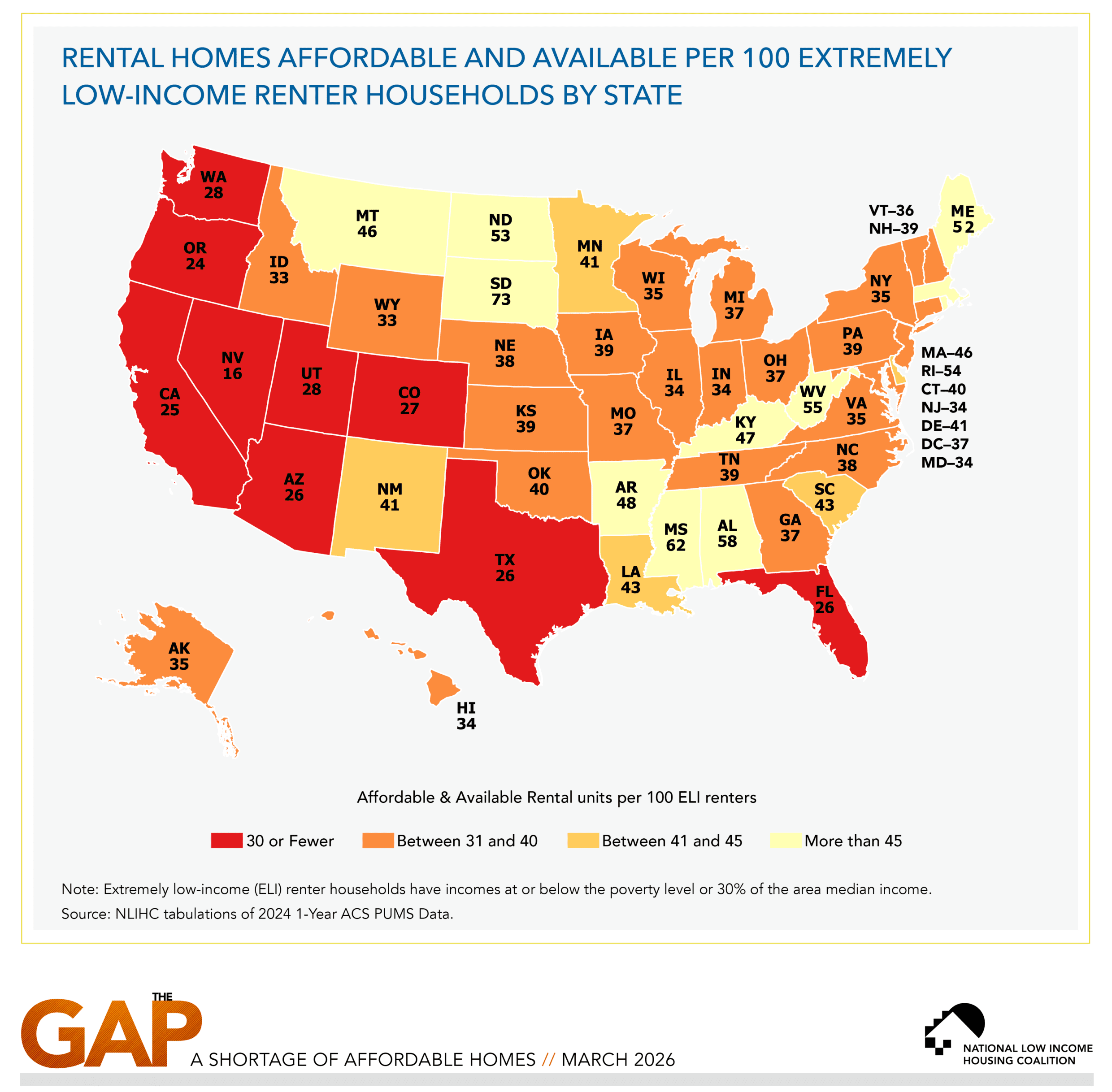
The supply nationwide ranges between 16 affordable and available homes for every extremely low income renter household in Nevada to 73 in South Dakota. And North Carolina is growing increasingly more expensive for already cost-burdened households to continue living in their homes.
For North Carolina, this report reveals that there are only 38 affordable and available rental homes for every 100 of the almost 350,000 extremely low-income (ELI) households in North Carolina. This is a decrease from 41 affordable and available rental homes per 100 ELI households in last year’s Gap report, meaning there are less affordable and available rental homes for these households. When housing isn’t available or affordable, we know that this leads to difficult decisions and often shows up in the data as cost burden or severe cost burden.*
 North Carolina Data Highlights
To truly grasp the pressure on ELI households we have to consider this data in two parts. Part 1: Remember that cost burden means a household is spending more than 30% of their gross income on their rent or mortgage (50% if they are severely cost-burdened). Part 2: This report specifically looks at the cost burden rates for households that are considered ELI or low-to-moderate income (LMI), meaning many of these households are earning no more than $25,000 a year in many parts of our state. So this cost burden doesn’t simply cut into optional budget items, but foundational expenses for a good quality of life such as food and health care.
North Carolina’s Cost-Burdened Households
In North Carolina, over 1.2 million households are cost-burdened, almost 30% of our state’s population. Of this number, 49% are renters, who are disproportionately cost-burdened. But this is not an issue that excludes homeowners by any means, with 20%–1 in 5–experiencing cost burden.. ELI households are the most significantly impacted by housing cost burdens in North Carolina. According to the 2025 HUD Income Limits for the state of North Carolina (this varies by Metropolitan Statistical Area), 1 person is considered ELI if they earn $19,950 a year. A two-person household is considered ELI at $22,800 per year, a three-person household at $25,650 per year, and a four-person household at $28,500. There are approximately 345,000 ELI households in North Carolina according to the Gap report.
Approximately 89% of those ELI households in North Carolina, are experiencing cost-burden. Almost 9 out of every 10 ELI households in NC are struggling to afford where they live.
No income level is immune to cost-burden. For households earning between 50% AMI ($47,500) and 30% AMI ($28,500), approximately 76% of them are experiencing cost-burden. For households earning between 51-80% ($47,500-$76,000) about 53% are experiencing cost-burden, and for those earning between 81-100% ($77,000 and up) about 25% of those households are experiencing cost-burden.
Source: FY2025 HUD State Income Limits
Cost-Burden in North Carolina Metropolitan Areas
In addition to providing data at the state level, The Gap report provides in-depth analysis of the top 50 metropolitan areas in the County, three of which are in North Carolina:
- The Charlotte-Concord-Gastonia (NC-SC) Metropolitan Area has approximately 75,000 extremely low-income renter households but only 22,891 affordable and available homes, or 31 per every 100 of those households.
- The Raleigh-Cary (NC) Metropolitan Area has over 47,000 ELI households and only 14,000 affordable and available rental homes, or 29 per every 100 of those households.
- The Virginia Beach-Chesapeake-Norfolk (VA-NC) Metropolitan Area has almost 57,000 ELI households and less than 15,000 affordable and available rental homes, or 26 per every 100 of those households.
What does this mean for our work?
The Gap report is not a surprise. Its contents represent the vast systematic nature of the housing need in our country and state. The housing supply shortage is impacting everyone, especially those at the extremely low and moderate income levels who are already experiencing a disproportionate amount of pressure due to limited means and limited options. This data reminds us of many things we already know:
What extremely low-income renters can afford to pay for rent does not cover the development and operating costs of new housing and is often insufficient to provide an incentive for landlords to maintain older housing. We know that the private market alone does not and cannot provide housing that is affordable to extremely low-income renters or moderate income renters without any kind of subsidy.
The result is a systemic shortage of affordable housing for extremely low-income renters impacting nearly every community, including in North Carolina.
We need to consider solutions that not only increase supply but that make sure it is attainable for a range of people across North Carolina through investing in affordability measures like subsidies or stabilizing solutions like property tax relief, rental assistance, foreclosure prevention and more to support people’s ability to stay in their communities.
Now more than ever, we have to coordinate across sectors and siloes and communicate what is happening on the ground level, to each other and to elected officials at every level.
The need for housing that is affordable and accessible to the needs of communities across the country and our state is not new. If anything, the need is increasing in its breadth and depth, because housing is a human right and a fundamental need, a crisis in this area cannot be ignored or cannot be solved simply or impractically.
Learn more about The 2026 Gap Report by visiting: https://nlihc.org/gap.
For more information on the gap of affordable units in North Carolina, click here.
For data by county regarding cost-burden in North Carolina and other metrics to show the housing need in our state, click here to visit and review our 2026 County Profiles.