This week, the North Carolina House Finance Committee advanced HB1089, which proposes a constitutional amendment to require statewide levy limits on property taxes. Proponents of the bill claim a levy limit will provide relief for cost-burdened homeowners. However, our analysis shows that on average, a levy limit will save homeowners less than $100 per year while counties will lose up to 20% of their revenue for schools, infrastructure, and public safety. The data gives us a broader picture of which counties will face the most severe impacts and how a levy limit will ultimately be detrimental to local governments.
Property Taxes Increase Due to Federal, State Cuts
According to the Wake County Manager, $600 million (35%) of Wake County’s 2027 budget are costs that have shifted from the state to local government, requiring a 2-cent property tax increase. This reflects a growing trend across the state as counties struggle to fill funding gaps left by the withdrawal of state and Federal funds. In fact, Wake County’s proposed increase is far less than a majority of counties that revalued property last year: 16 counties, mostly rural NC counties, raised their levy by more than 5% above revenue neutral to fill budget gaps. Six counties increased their 2025 property tax levies by 10% or more, including three smaller Tier 1 counties, in order to make their budgets.
If the state of North Carolina continued to provide previous funding levels to Wake County, the county could drop their property tax rate by 19 cents. Adequate state and Federal funding could lead to similar property tax decreases across the state. However, property taxes are currently one of few tools that counties have to make up for these funding shortfalls.
Methodology
To estimate the impacts of a levy limit, we compared counties’ budgeted property tax revenues in their most recent revaluation years to their hypothetical revenue if two different types of levy limits had been in place. A future levy limit would likely have comparable impacts to county budgets. You can see more details about our method in our full analysis.
Fiscal Impacts: Hundreds of Millions of Dollars Lost
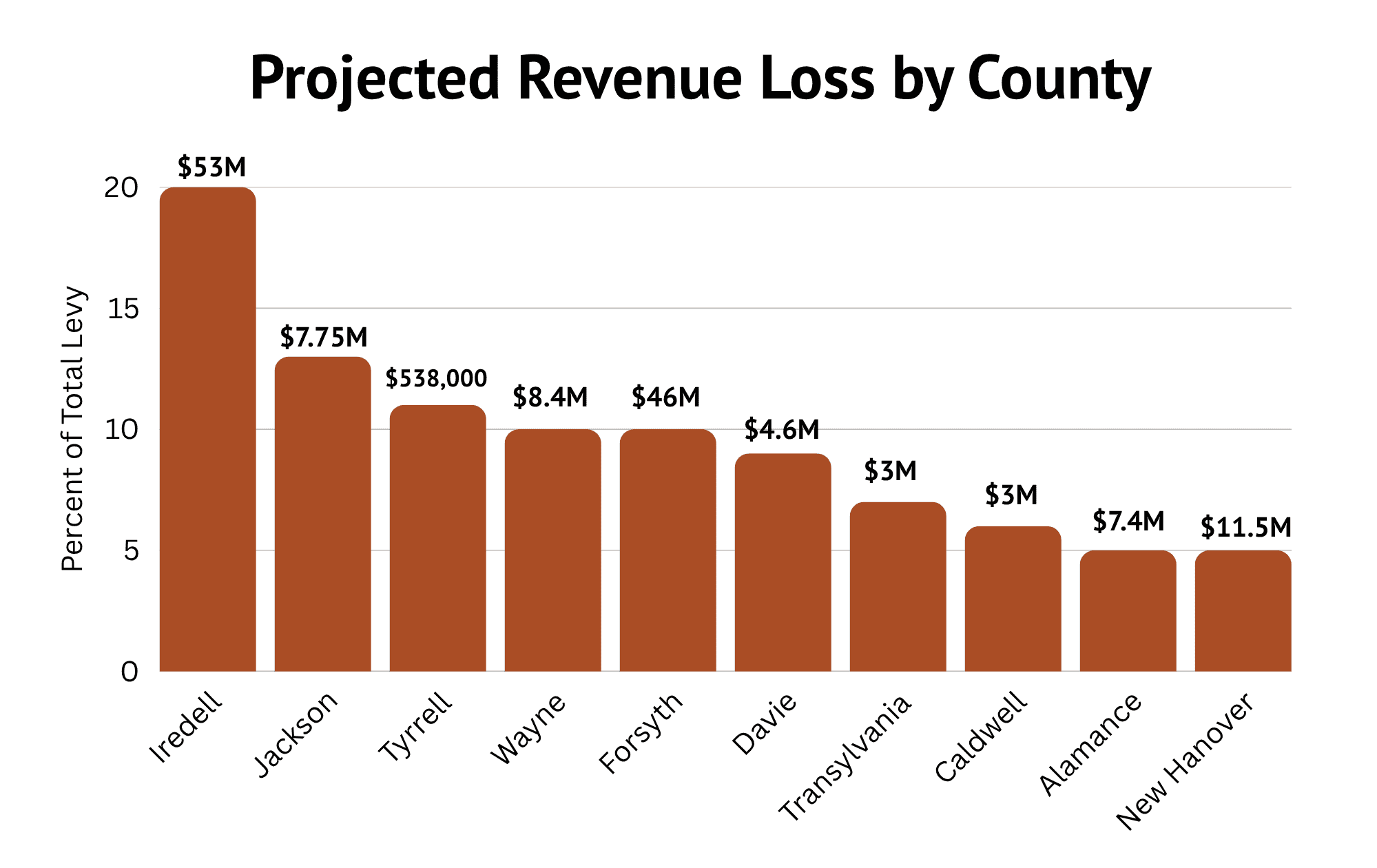
The total fiscal impact of a levy limit in just ten counties analyzed ranges from approximately $110 to nearly $150 million per year depending on how strict the levy limit is. Forsyth is the only county among these that is also one of the state’s ten largest counties, and the analysis includes Tyrrell, NC’s smallest county, so this estimate is not skewed by county size. The likely impact statewide could be well over $1 billion less in critical funding for school, infrastructure, public safety, and more.
The three counties that would have seen the greatest fiscal impact in our analysis are spread across the state and demonstrate the impact of this on vastly different counties. Had a levy limit been in place at its last revaluation, Iredell County, including Statesville and Mooresville, would have lost up to $53 million in property tax revenue, nearly 20% of the total levy. Jackson County would have lost around 13% of its property tax revenue, and Tyrrell County would have foregone 11% of its property tax revenue.
Tier 1 Counties
Counties often cited as having “high taxes” are not necessarily the same counties that would experience the largest impacts under a levy limit. In our analysis, smaller counties faced disproportionate financial strain: Tyrrell, Wayne, Stokes, and Martin counties lost nearly 10% of their property tax revenues. Last year, six counties increased levies by 10% or more above revenue-neutral after their 2025 revaluations. Half of those were smaller Tier 1 counties with low per-capita tax bases, including Tyrrell, Warren, and Wayne Counties. The remaining counties included Jackson, Person, and Chatham. Over the last five years, a similar pattern is noticeable: nearly half of counties who have increased their tax rates more than 10% above revenue neutral have been Tier 1 counties.
Minimal Property Tax Relief
Despite the significant revenue loss to counties, homeowners experience little property tax relief under a levy limit. In Tyrrell County, the average homeowner pays around $1,200 in property taxes. The strictest levy limit after last year’s revaluation would have saved this homeowner about $120 this year, or just $10 per month, while taking nearly 11% from Tyrrell’s limited property tax revenue.
In Winston Salem, a strict levy limit would have saved a homeowner paying $3,000 this year just over $200. Meanwhile, it would have cost Winston Salem and Forsyth County over $45 million in property taxes in a year when the deficit in the county school system was nearly exactly that amount.
Targeted Property Tax Relief Is More Effective
Expanding property tax relief programs—particularly the Homestead Exclusion and Circuit Breaker—would more directly assist cost-burdened homeowners while producing a much smaller and more targeted fiscal impact. In fact, the Tier 1 counties would see very little fiscal impact from the changes we recommend in our resource “Meaningful Property Tax Reform & Relief in NC.” These tools would also be especially important for elderly homeowners on fixed incomes in high-cost and fast growing counties who aren’t currently reached by statewide programs, helping them in far more substantial ways than levy limits would.
What Happens Next?
HB1089 will advance to the House Rules Committee. At the same time, House and Senate leadership have announced a tentative budget agreement that includes passing HB1089 in addition to a state income tax cap of 3.5%.
Advocacy Opportunities & Recommendations
Despite the bipartisan support for reforming existing property tax relief programs, the dangerous pace and focus on HB1089 puts this and so many other crucial services in jeopardy. The numbers and facts are clear on what will actually provide relief for cost-burdened households in North Carolinians, and HB1089 is NOT IT. For any and everyone concerned about this in North Carolina, here are few advocacy action items that can be taken:
If you are an elected official or local government administrator and would like to share the impacts that this proposal would have on your county’s ability to invest in other services, please feel free to share them by emailing policy@nchousing.org.
Urge your representative to oppose the “levy limit” legislation.
- State legislation on property taxes should improve fairness, increase transparency, and provide real relief for cost-burdened homeowners without hamstringing local governments. This proposal does none of those things.
Urge your representatives to expand and improve existing property tax relief programs, especially the Circuit Breaker program.
- Removing the deferral provision and age requirements would help thousands of cost-burdened families statewide remain in their homes.
- Feel free to use our 2026 County Profiles which have cost-burdened household data in them for all 100 counties as well as the state.
Even though HB1089 passed the House Finance committee, it still has to pass both the House and Senate, to find your legislators use the “Find my Legislator” tool by clicking here. Make sure to check to see if they are on key committees such as House Rules or Senate Finance or if they have other key leadership positions as well.
The next few weeks are critical, we must keep engagement and communication strong. Use your voices today to advocate for real relief for North Carolinians.