Durham loves to talk about growth. You see it in the development of new modern downtown amenities and the townhomes rising along major corridors. You hear it in Vision Zero presentations promising safer streets and in bond referendums funding new sidewalks. Public officials speak confidently about future investment in land use using the language of equity and inclusion. On paper, it appears that progress is moving in the right direction. However, if you drive just a few miles east of downtown, along Cheek Road toward the Merrick-Moore neighborhood, growth is experienced much differently. In Merrick-Moore, growth sounds like freight trucks barreling past an elementary school as children try to get home. It feels frustrating to see heavier cut-through traffic on streets never designed for it. It shows up in rising property tax bills for elders on fixed incomes, and it looks like aging homes in need of repair while investors quietly circle nearby and send leaflets promising cash for keys to anyone willing to sell their house. Here, growth has arrived in the neighborhood through displacement pressures. To understand what unequal development costs, you have to leave downtown and visit longstanding communities at the edge of the city.
When Growth Moves Faster Than Protection
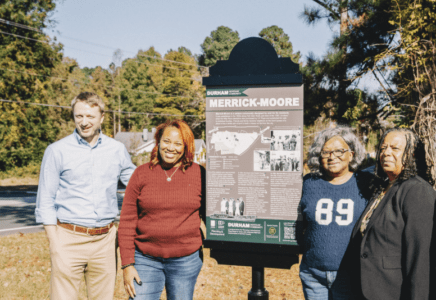
Merrick-Moore sits just 2.5 miles east of downtown Durham. The neighborhood is close enough to see the city’s transformation, but far enough to experience its consequences in vastly different ways. To the west, I-885 forms a barrier between the neighborhood and most of Durham. To the east, new industrial and residential developments have sprung up. Cheek Road, once a rural ‘farm to market’ road, cuts the community in half and carries more than 15,000 vehicles a day at dangerous speeds, with each vehicle posing a risk to residents checking their mail, working their yards, or walking their dogs. Roughly half the neighborhood lies north of Cheek Road, along with Merrick Moore Elementary School, where children cross streets that were never designed for this volume or speed.
This is a historically Black, post–World War II neighborhood settled by returning veterans and their families. Many homes were built by hand, and several have remained in the same families for generations. Merrick-Moore High School, which is now the elementary school, made a name for the community by winning statewide football championships. For decades, Merrick-Moore has been a stable, working-class community shaped by neighborhood-built institutions and deep social ties. But as Durham has grown, Merrick-Moore and other neighborhoods at the city’s edge have absorbed development in uneven ways. New massive subdivisions now back directly onto longtime residents’ yards without recognition of the community itself. Traffic has intensified. Property taxes have climbed. However, basic infrastructure continues to lag behind with incomplete sidewalks, persistent flooding, and seniors living in aging housing without home repair support.
While the tight-knit community has organized neighborhood associations and improvement efforts since its founding, the continued marginalization of Merrick-Moore reveals something larger. When growth is driven primarily by market incentives and layered over histories of racial exclusion and uneven public investment, the promised benefits of growth do not unfold evenly. Development moves quickly where capital concentrates, while meaningful community engagement and protections for longstanding residents move more slowly. For Merrick-Moore, this pattern is tangible in everyday infrastructure.
One of the neighborhood’s prominent organizations, the Merrick Moore Community Development Corporation (MMCDC), has worked around equitable development for the last five years. As Ms. Bonita, the Executive Director of MMCDC and longstanding resident who lives in the house her father built in 1948, explains, “We can’t just sit back…If we don’t show up, they’ll decide the future of the neighborhood for us.” Her statement speaks to much more than civic participation. In a planning environment where growth is treated as neutral and inevitable, not showing up means accepting that decisions about your neighborhood will be made without the community. The history of Milan Woods illustrates this dynamic. When Milan Woods was built along Merrick Moore’s northern edge in the 1990s, the builder intentionally created a divide between the neighborhoods, constructing a berm to block access. While residents wished for connecting streets between the two communities, Ms. Bonita recalls that the developer was concerned that the appearance of the homes in Merrick-Moore would bring down the property values of Milan Woods. This demonstrated to the neighborhood that growth could happen next to Merrick Moore, but not with it. This pattern of development encircling a neighborhood while leaving its infrastructure unresolved remains a reality today.
Building Protections Before Displacement
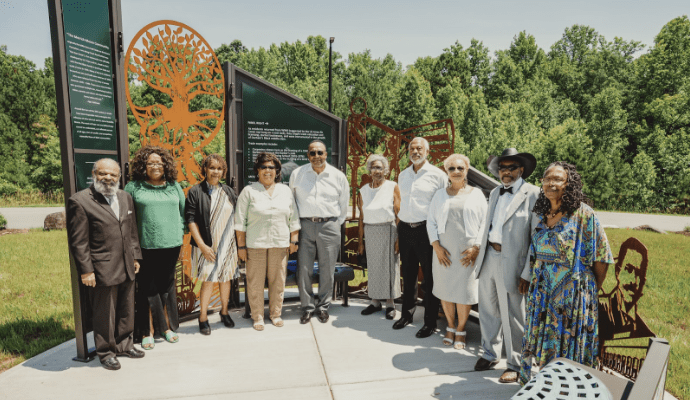
It is within this uneven terrain that MMCDC works to chart a strategy for equitable development. The organization formally received state incorporation as a nonprofit in 1997 and federal designation in 2022, building on the legacy of the original Merrick Moore Community Club once led by Ms. Bonita’s father. Incorporation provided the neighborhood with the capacity to pursue funding, formalize programs, and strengthen its leverage in conversations with the city.
At first glance, MMCDC’s initiatives may appear varied as the organization has organized a community garden, home repair assistance, digital literacy training, and transportation advocacy. However, in reality, together, these initiatives form a cohesive strategy that melds environmental, housing, and transportation justice to address and advocate for community needs across neighborhood issue areas. The outcome is a cohesive strategy that beautifies and brings dignity to the neighborhood, while working to stabilize residents before market pressures and planning negligence can displace them.
The Samuel Green Sr. Community Garden, created after clearing nearly two acres of overgrown land by hand, serves as both a gathering space and a response to food insecurity in a neighborhood long overlooked by grocery investment. ARPA funding supports home repairs for elders living on fixed incomes, preventing minor maintenance issues from escalating into code violations or foreclosure. Digital literacy training ensures that seniors can navigate online city meetings, tax portals, and service systems in a municipality that increasingly conducts engagement digitally. Through Healthy Homes and Green Jobs programming, MMCDC has partnered with the Bragtown Neighborhood Association to implement rain gardens and energy efficiency improvements that reduce flooding risk and stabilize aging homes. They fought to ensure that a new park would carry the name Merrick Moore, preserving the legacy of John Merrick and Dr. Aaron McDuffie Moore rather than allowing it to be renamed in ways that obscure Black history. The community continues to push back on transportation plans that prioritize regional growth and commuters over neighborhood safety.
Taken together, this work reflects a clear philosophy that demonstrates that housing stability, environmental resilience, mobility access, and neighborhood identity are not separate issue areas. They are interconnected conditions of remaining in place. In this way, MMCDC’s efforts offer how to build a counter-model to market-centered growth. Rather than assuming that equity will follow expansion, the organization prioritizes protection as the foundation of development. Ms. Bonita puts it clearly – “We’re trying to help people stay in their homes.”
What Merrick Moore Can Teach the Triangle and Beyond
Market-centered growth operates on the premise that sufficient development and capital investment will ultimately result in greater equity. However, when such development occurs within contexts marked by longstanding exclusion and misrecognition, expansion alone may fail to address, and can even exacerbate, existing inequities. The circumstances observed in Merrick-Moore illustrate a broader trend within the Triangle region – land values increase without corresponding tax relief, new amenities are introduced without ensuring baseline safety, higher density is achieved without adequate infrastructure, and planning policies change without considering the needs and aspirations of long-time residents. As a result, historically marginalized neighborhoods are frequently required to bear the adverse impacts of growth while awaiting appropriate safeguards. Visions of a someday progressive future become justifications for continued present day neglect.
As Durham evolves, there’s an ongoing concern about whether growth will keep depending on established communities to bear risks without receiving proper acknowledgment. If equity is a genuine priority for the city, protections should be implemented as swiftly as profits are pursued. Essentials like home repairs, sidewalk creation, drainage improvements, and tax stability need to be seen as foundational elements for inclusive progress rather than overlooked details. In neighborhoods shaped by exclusion and resilience, growth isn’t measured by how fast new developments appear, but by whether longtime residents can stay, benefit, and actively help direct change. Merrick-Moore isn’t against development. It’s simply asking for the city to prioritize dignity and stability.