“What Would a Levy Limit Mean for You?” The John Locke Foundation posed this question with the release of their “NC Property Tax Savings Calculator” last week. The calculator intended to show potential individual property tax savings for homeowners ahead of November’s election, when voters will decide whether to require lawmakers to limit how much local governments can collect in property taxes. However, the underlying data contained a significant calculation error which drastically inflated reported savings. John Locke Foundation has since taken down the calculator and retracted the data, but not before the incorrect data circulated online and in the media. For this reason, it’s worth reviewing the significant calculation error, the corrected data, and the other methodological issues that make even the updated results misleading.
Spreadsheet Error Inflated Reported Taxpayer “Savings” by over $5.3 Billion
The calculator stated that it took annual inflation into account in its formula. The underlying data provided by John Locke Foundation showed that, while the formula appeared to include the inflation rate, the formula actually pulled from empty cells in the spreadsheet, leading to the inclusion of “0” for inflation for 99 of 100 counties calculated across all five years of the analysis (Alamance is the exception). Here’s a video walk through showing the data error.
This careless error in the underlying data – where a crucial variable, the inflation rate, was left out of the calculations across all five years of its analysis – has significant implications on John Locke Foundation’s claims. When this calculation is corrected, the analysis shows collective “savings” of $230 million, not $5.9 billion – 25 times less savings than John Locke Foundation initially claimed and circulated last week.
The corrected formula also shows that individual homeowners would only save 1.7% on average under a levy limit, not the average 12% savings the calculator asserts.
To put this in perspective, if you are a property owner in Mecklenburg County who looked up your “savings” using the calculator from the John Locke Foundation, the retracted calculator claimed that under a levy limit, you would save 9% off of your 2026 tax bill. But it turns out that in Mecklenburg, there would be no savings to individual taxpayers with the corrected formula using John Locke’s methodology.
Other Corrected County-Specific Examples Using John Locke’s Methodology
By correcting the formula error in John Locke Foundation’s data, the reported savings for homeowners drops substantially in all 99 counties where inflation was left out. Here’s a few examples:
| Homeowner Savings: Incorrect Formula | Homeowner Savings: Corrected Formula | Incorrect Calculator: Savings by Avg Homeowner | Corrected Calculator: Savings by Avg Homeowner | |
| Beaufort County | 3% of your 2026 property tax bill | -10% of your 2026 property tax bill (no savings) | $24 | $0 |
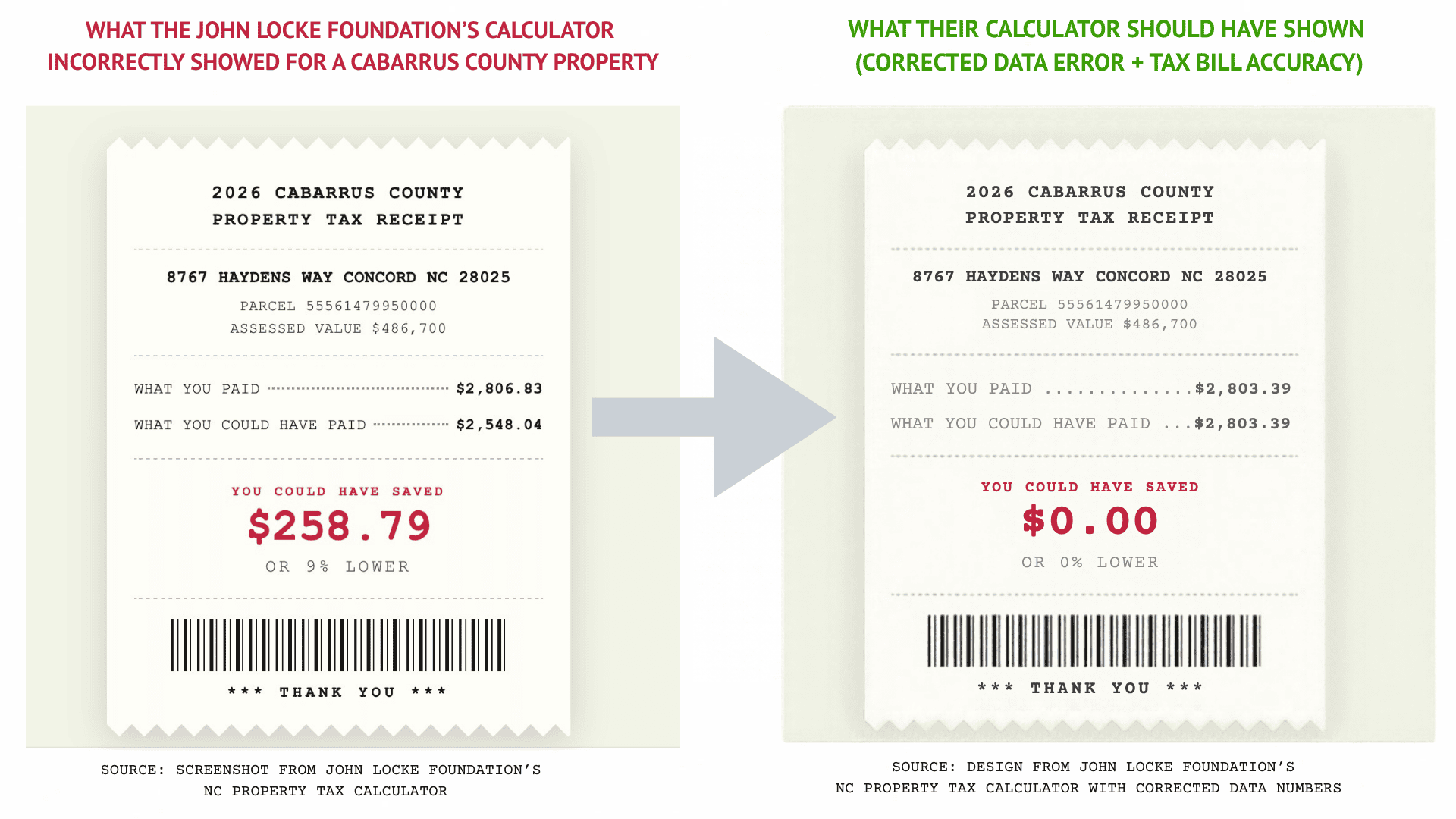
| Cabarrus County* | 9% of your 2026 property tax bill | -3% of your 2026 property tax bill (no savings) | $188 | $0 |
| Caldwell County | 12% of your 2026 property tax bill | 0.4% of your 2026 property tax bill | $109 | $4 |
| Wake County | 13% of your 2026 property tax bill | 1.5% of your 2026 property tax bill | $327 | $37 |
*Note: Cabarrus County is used as an example in John Locke Foundation’s retraction press release to double-down on its claims about certain counties far exceeding levy limits, despite the fact that in their own corrected analysis, individual taxpayers would have seen no savings in Cabarrus County.
**Savings by average homeowner use Locke Foundation’s tax levy formula (incorrect vs correct) and the median county-only tax bill using the Tax Foundation’s median county tax values alongside current property tax rates
Simply correcting John Locke Foundation’s own analysis – which has additional underlying methodology issues – shows that the vast majority of North Carolinians will not experience significant savings from a levy limit. The NC Housing Coalition released a levy limit analysis in August that similarly illustrates that individuals will gain very little from a levy limit. Instead, the largest beneficiaries of a levy limit are corporations like Duke Energy, who would save millions while local communities lose funding for schools, emergency services, and other locally-funded services.
Additional Methodological Concerns with John Locke Foundation’s Analysis:
In addition to such a significant calculation error, the underlying methodology used to show individual property tax savings was flawed:
- Not accounting for new construction leads to inflated taxpayer savings: The hypothetical levy limit in John Locke Foundation’s analysis did not account for new construction growth in counties, which is typically included as a key growth measurement in levy limits in addition to population.1 This approach does not align with existing levy limits from other states, including those promoted by the Tax Foundation that led to the amendment proposal.
- Inclusion of pandemic years biases results: John Locke Foundation’s analysis presumed a start date for a levy limit as the year of the pandemic, when inflation rates were far lower and drastic funding shifts at all levels of government resulted in abnormal budgets. That year was presumably included because the abnormal property tax budgets from that year skewed the data results in the Foundation’s favor. In fact, after correcting the spreadsheet error, all of the remaining “taxpayer” savings result from inclusion of the pandemic years.
- The calculator masked larger corporate savings: John Locke Foundation presented their data as individual taxpayer savings, but the vast majority of the “savings” from a levy limit would go to the largest corporate landowners, especially utility companies like Duke Energy and data center owners like Meta, Apple, and Amazon. The calculator did not allow you to input large commercial property addresses, yet it included those “savings” in their inflated total statewide numbers.
- More errors likely:The calculator allowed you to insert a residential address and brought up an image that said “Property Tax Receipt” and included a line that stated “What You Paid.” From a sample review, the tax values seemed correct, but in several counties tested, including larger counties like Cumberland and Wake, the tax bill did not match the actual county tax bill records, indicating another potential formula error.
The constitutional amendment on property tax levy limits that voters will see on their ballots is vague, making it difficult to understand how it will affect their households and communities. It is important that analysis and tools intended to help voters understand the potential impact of a levy limit are accurate and as methodologically sound as possible. You can read NC Housing Coalition’s analysis on the effects of a levy limit here.
Footnotes:
1This is a significant oversight because it implied that new construction could not add property tax revenue to county budgets, which could undermine the ability for counties to pay for the extension and management of services for this growth.