Between reconciliation, recissions, and RIFs–and with North Carolina being the only state in the country without a comprehensive budget–the policy space at the federal, state, and local levels has been quite eventful. This 2025 Policy Wrapped is an chronological overview of the year through a housing, homelessness, and community development lens. In reviewing the year, we can better assess the unprecedented threats to our housing ecosystem and forecast what might be to come in 2026.
 New Year
In January, new executive branch leadership was sworn in at the Federal and state level. Within the first 100 days alone, President Donald Trump quickly set a record for the number of executive orders (EO) issued (143) in the first 100 days of his presidency. For context, President Trump has issued more Executive Orders this year than he did during all 4 years of his previous term combined. These events reversed policies from previous administrations, restructured federal agencies, and implemented new regulations.
One powerful example of this can be seen in the January 27, 2025 memo M-25-13, released by the Office of Management and Budget that directed all federal departments and agencies, including HUD, to temporarily freeze all federal financial assistance programs the following day. On the OMB list, most federal funds were to be paused indefinitely, including the national Housing Trust Fund, HOME Investment Partnerships Program, Community Development Block Grants, Homeless Assistance Grants, USDA Rural Development, Fair Housing and Housing Counseling – just to name a few. The memo was rescinded on January 29, 2025 after dozens of challenges from attorneys general across the country, however due to confusion caused by the memo and other internal administrative decisions programs were still significantly impacted. And in the weeks prior to and after the memo was released and then rescinded, several agencies reported being locked out of the payment processing systems or experiencing technical difficulties or delays even with funds already appropriated and encumbered. HUD also cancelled several contracts and froze millions in Section 4 funding for community development with Enterprise Community Partners and Local Initiatives Support Corporation. These were just a handful of the actions that took place within the first few months of 2025, that would not only foreshadow the year ahead, but lay shaky groundwork for any budget and spending negotiations and agreements (or lack thereof) for the remainder of the year. This set the stage for conversations about the One Big Beautiful Bill Act (OBBA) and FY26 budget, allowing them to quickly become the center of attention.
Summer
Around the height of the summer, we heard a lot about reconciliation, and the OBBA passed with a tie-breaking vote from Vice President J.D. Vance on July 13, 2025. This legislation, despite providing While this legislation included provisions that improve the housing credit and other promising tax credit programs, it also included dangerous policy changes and cuts to key social programs. These provisions will impact many states like North Carolina who have trigger provisions that would require either ending Medicaid expansion or revisiting expansion in the event that the federal government’s matching rates drop. This means hundreds of thousands of people at the lowest end of the income spectrum are at risk of losing their healthcare coverage. This kind of blow goes beyond housing costs, yet will likely increase the need and severity of our housing crisis.
Before leaving for August recess, the Senate Banking Committee, for the first time in over a decade, unanimously passed the “ROAD to Housing Act of 2025” through markup. This legislation, led by Chair Tim Scott (R-SC) and Ranking Member Elizabeth Warren (D-MA), represents the committee’s first bipartisan housing markup in over a decade. The Act includes over 40 provisions that seek to expand and preserve supply, increase access and affordability, and reduce homelessness, including:
- Flexible funding for jurisdictions actively building new housing and facilitating the conversion of vacant and abandoned buildings into new housing.
- Reforms to the US Department of Agriculture (USDA) Rural Housing Service programs like decoupling rental assistance from maturing mortgages and the permanent establishment of a housing preservation and revitalization program.
- Guidance to modernize the Federal Housing Administration (FHA) lending standards to support the use of manufactured housing.
- Lifting the Rental Assistance Demonstration (RAD) program cap and extends protections for tenants in RAD buildings.
- Incentives for applicants of federal project funding to adopt pro-housing policies including by-right zoning and reduced parking minimums (Build More Housing Near Transit Act, Section 211).
In addition, the legislation would have permanently authorized CDBG-DR funding, and would reauthorize the HOME Investment Partnerships program and the PRICE program for manufactured housing. To learn more about the Road to Housing Act Link click here for a section-by-section analysis of the bill as well as an in depth analysis of the bill by the National Low Income Housing Coalition – click here.
Fall
After returning from August recess and failing to reach an agreement on government spending, the Federal government entered a 43-day Federal shutdown on October 1–. After six weeks, the longest shutdown in Federal history came to an end. In an unexpected twist of events, Senate Republicans won the votes of 7 Democrats and 1 Independent, which gave them the minimum votes needed to pass a Continuing Resolution (CR). The House then passed the spending bill in a vote of 222-209 and it was signed into law.
The CR temporarily funds the Federal government through January 30. Alongside the CR, Congress passed a “minibus” that provides the full fiscal year’s funding for Veterans’ Affairs, Agriculture, and legislative operations. The spending package provides SNAP funding through September 2026 (the end of the fiscal year) and reimburses states for money spent to maintain SNAP programs during the shutdown. In addition, it provides legally required backpay for Federal workers and reverses layoffs that the Trump administration implemented at the start of the shutdown in October. The CR does not extend Affordable Care Act tax credits that expire at the end of the calendar year. As a result, annual health insurance premiums for North Carolinians who buy their insurance on the Marketplace will increase by an average of $670. The CR also does not prevent the Trump administration from rescinding previously committed funds. Congress has until January 30 to either pass the remaining 9 spending bills, pass another CR, or enter another shutdown.
End of Year
In the final weeks of 2025 there has been plenty to report, including belated and fundamentally different Notice of Funding Opportunities (NOFO) released and being rescinded, the continued absence of a NOFO for Housing Counseling, and strained efforts to get promising housing bills attached to end of year legislation like the National Defense Authorization Act (NDAA). NOFOs have been at the center of a lot of discussion this year in housing, community development and homelessness spaces. On November 13, 2025, only weeks before the original FY2025 awards were expected, the Department of Housing and Urban Development (HUD) released the FY2025 Continuum of Care NOFO. This action caused mass concern not only due to its belated release, but because it completely abandoned the previously approved two-year funding cycle and imposed a 30% cap on permanent housing funding (previously 87%). HUD withdrew the NOFO on December 8 and said it would revise and reissue it, but no timeline was provided. With awards not expected until May 2026 at the earliest and over one third of the current CoC awards expiring between January and June 2026, this means communities across the country, including North Carolina, will face months-long funding gaps that will put thousands of households at risk of losing stable housing. To see an analysis of the now rescinded NOFO, click here.
Amidst the funding uncertainty and chaos, there was a concerted, bipartisan effort to get the Road to Housing Act attached to the National Defense Authorization Act (NDAA). , The NDAA that passed both chambers and was sent to the President’s desk on December 17, 2025, is over 3,000 pages long, codifies several of executive orders, and sets national security spending levels. This version however, does not include any of the provisions in the Road to Housing Act due to presumed differences between the House and Senate. In response to this, the House unveiled the bipartisan “Housing for the 21st Century Act,” which contains some of the same provisions included in the Senate’s ROAD to Housing Act. Provisions in the bill include expanding manufactured housing opportunities and programmatic reforms for the HOME Investment Partnership program, Rural Housing Services’ Section 504 home repair program, and the Community Development Block Grant (CDBG) program. A week after its introduction, it passed the House Financial Services Committee by a 50-1 support and now moves to the House for consideration. Read a section-by-section summary here.
As this volatile year comes to a bumpy end, recent messaging from President Trump gives us insight to how 2026 might look on the housing front. In his recent address on the economy to the nation on December 17, 2025. In this speech he talked about the increased cost of homeownership and other affordability issues. In addition to sharing plans to change leadership and lower interest rates and mortgage payments President Trump stated that in the new year he would announce “some of the most aggressive housing reform plans in American history.”
We continue to express our deep concern with the dangerous rhetoric being broadcasted the national level, the attack on immigrants and our community’s ability to access healthcare and other critical social safety net resources as well as the lack of clarity coming from federal programs, and the increasing threat to critical federal housing programs and resources. These systems are by no means perfect, however, their dismantling via chaos and uncertainty is not only ineffective policy reform, but it is putting lives at risk.
North Carolina 2025 Policy Review
At the state level, the new legislative session kicked off in January. In addition to the transitioning in of a new executive branch, the beginning of the year was also marked by the creation of the Governor’s Recovery Office for Western North Carolina (GROW NC) as well as a visit by President Donald Trump to Western North Carolina post-Helene, where he began communicating his intent to dismantle FEMA.
Throughout the legislative session, the NC Housing Coalition’s Policy and Advocacy Team worked to reconcile the bills entered in our bill tracking database. This year our policy priorities fell into five key categories: Funding for Housing, Disaster Recovery, Statewide Coordination, Protections for Renters and Homeowners, and Land Use & Development.
Of the 1752 bills that were filed this legislative session (excluding resolutions), just shy of 190 bills aligned or could be organized into our policy priority areas, but only 30 of those bills survived crossover. The themes this session have been layered, and while we saw a problematic rise in legislation and rhetoric that criminalizes those experiencing homelessness, we also saw an immense amount of momentum and interest around property tax relief as well as land use reform in order to lower the cost of developing housing.
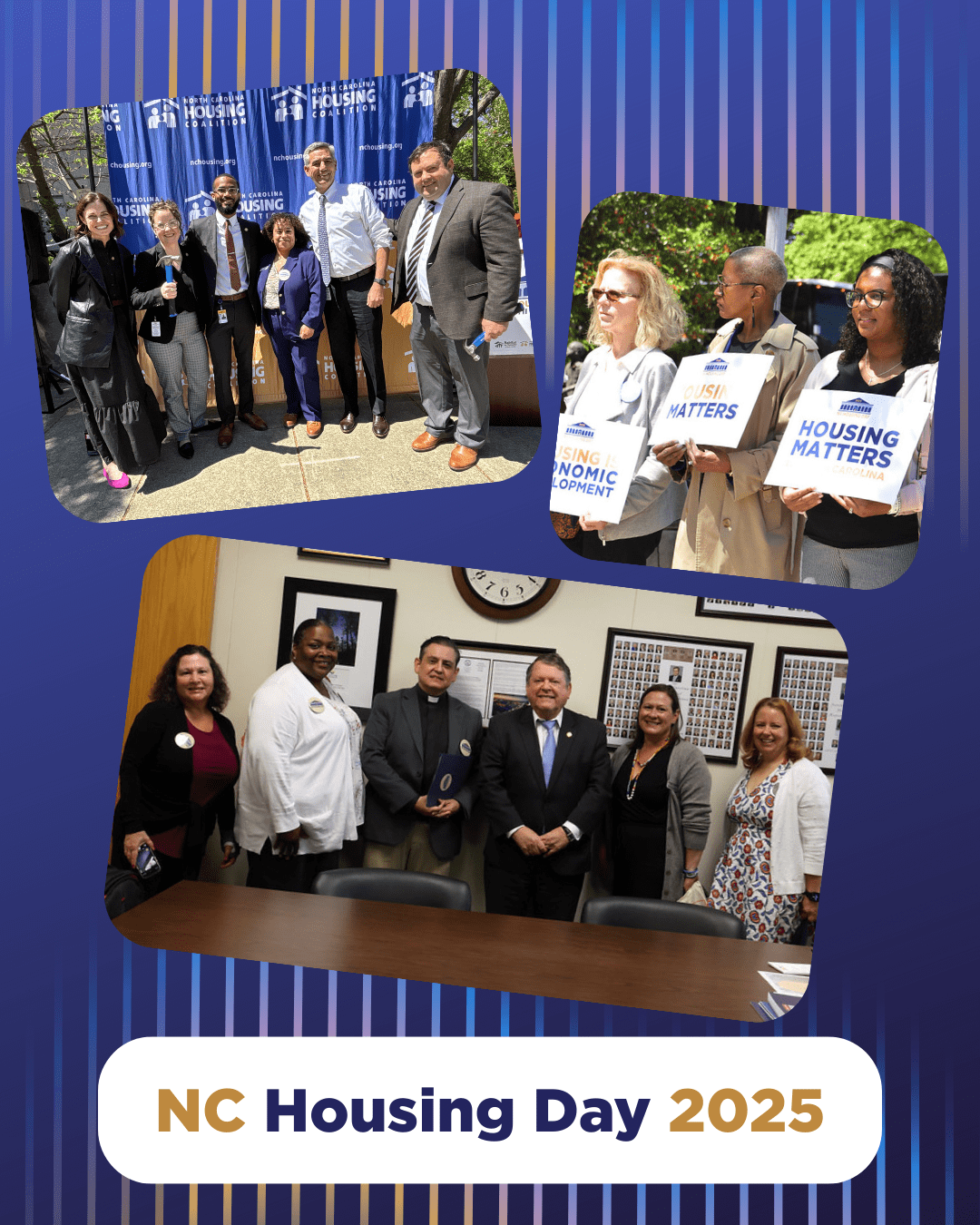 Our advocacy efforts saw several peaks throughout this year’s legislative session. In April, we hosted our inaugural NC Housing Day in partnership with Habitat for Humanity of NC and the NC Coalition to End Homelessness. 117 people representing 49 counties held 111 meetings with elected officials. We will be hosting this event again on April 28-29, 2026 and are excited to welcome a fourth partner, the NC Coalition of Land Trusts. Sign up for updates.
In August, our team released a comprehensive legislative summary. A month later at the end of September, we reached the one year anniversary since Helene. It’s important for us to look back not only on the damages, but also on the way communities have continued to show up for each other as our friends in Western North Carolina work to rebuild and recover. We continue to work with our cross-sector partners through the North Carolina Inclusive Disaster Recovery Network (NCIDR) to encourage investment in housing resources like rental assistance, foreclosure and eviction prevention, housing counseling and more as well as improved statewide coordination to address both recovery and resiliency components of this long journey ahead. These components will require coordination, and investment for years to come.
This fall our advocacy around housing investment has increased significantly in the absence of a state budget. At a time when communities are already facing housing shortages, and funding volatility, this absence puts even more pressure on renters and developers alike. More importantly, it severely hinders North Carolina’s ability to invest in building critically needed affordable workforce housing.
When the NC Housing Finance Agency announced the 2025 Low Income Housing Tax Credit (LIHTC) Awards in late August, every new construction tax credit project that was awarded and all but one rehab project demonstrated the need for gap financing such as the Workforce Housing Loan Program (WHLP). Across 24 counties, 29 projects across will be receiving 9% tax credits, creating a total of 1,503 units. An additional 20 developments were awarded tax-exempt bonds that will total 3,439 units. In total, North Carolina will see 4,942 units of affordable housing over the coming years. Click here to see this year’s awarded projects.
Without new budget appropriations, WHLP will not receive any funding, which will stall shovel-ready projects and slow the future development pipeline for much needed workforce housing. As part of advocacy and research efforts, our Policy Team created and continues to update a database of all Traditional WHLP Awards since the program’s inception. Additionally, the NC Housing Coalition put out a call for signatures for a letter asking NCGA leadership to restore WHLP funding. As of December 17, 2025 the letter received 114 sign-on responses from both individuals and organizations. We have been extremely thankful to see support and energy around this call to action from across the state. Some of the organizations that signed on to the letter include, NC Realtors Association, NC Home Builders Association, Habitat for Humanity of North Carolina, NC Council of Churches, Woda Cooper Companies, NC Budget & Tax Center, Centrant Community Capital, Mountain Housing Opportunities, DHIC, CAHEC, Center for Community at Self Help, and dozens more.
In the final weeks of the year, unfortunately North Carolina is still the only state in the country without a comprehensive state budget.
Last but certainly not least, we have found consistent hope and renewed energy from work accomplished at the regional level through the partner of true community based and centered power. Over the last 10 months, staff of the NC Housing Coalition’s Community Justice Collaborative has worked alongside a coalition of longstanding residents, neighborhood organizers, and rooted organizations across Orange County who have uncovered inequities and led the way to ensuring property tax justice. Over 500 longstanding Black residents across the county participated in this effort, informed data analysis, and led efforts for change. As a result of their advocacy, Orange County is undertaking steps to address these inequities. The Orange County tax office identified 171 neighborhoods to review for the possibility of neighborhood-wide adjustments, including the 19 the Coalition’s analysis highlighted. They’ve made adjustments to four Historically Black neighborhoods so far and hired an experienced consultant making recommendations for additional neighborhoods in the coming weeks. They’ve also started a working group to review the assessment process. These efforts have resulted in an estimated $3 million in overassessed property taxes for longtime residents in a dozen Historically Black neighborhoods.
Despite a year filled with unprecedented change and volatility, we continue to see the power of community and this fortifies our resolve in ensuring every North Carolinian has a home in which to live with dignity and opportunity.
Looking Ahead to 2026
Based on the year that we’ve had, it’s hard to make any predictions about what 2026 will bring for housing and community development. Key sources of Federal funding are still delayed, and proposed policy changes would upend current programs and put thousands of North Carolinians at risk of losing their housing or other crucial services. The lack of a state budget is stalling LIHTC projects, and the proposed reduction or elimination of WHLP could result in the loss of affordable thousands of units over the coming years. Proposed legislation to criminalize homelessness and the state and local levels also threatens to hamper local program design and further harm some of the most vulnerable members of our communities. On both the state and Federal level, the outlook for the future of housing funds, programs, and services is grim.
At the same time, we have reasons to hope. The extreme funding and policy changes put forth by the Trump administration are being challenged in court. Between our WHLP letter and our upcoming NC Housing Day, dozens of organizations and hundreds of advocates will continue to pressure our state lawmakers to invest in housing and to drop harmful bills. At the regional grassroots level, the Community Justice Collaborative is making local wins for housing and property tax justice and developing resources for communities across the state. And the NC Housing Coalition will continue to lead a movement to ensure that every North Carolinian has a home in which to live with dignity and opportunity.
It is more important than ever to stay connected to the latest housing news and policy updates. The NC Housing Coalition provides weekly updates that you can access through our weekly Housing Call, our Housing Matters 2 NC podcast, or our Weekly Policy Update emails through our Housing Matters listserv. You can also sign up for updates on our 2026 events: NC Housing Day (April 28-29), Bringing It Home (May 28), and NC Affordable Housing Conference (October 22-23).
All of our resources and advocacy tools are free and publicly available thanks to our supporters, and we need your support in order to maintain our news, policy analysis, programs, and advocacy. This work doesn’t happen without you. Donate today to sustain our work as we head into 2026.
Individuals
Adwoa Asante
Brittany Badgett
Tara Bailey
Barbara Barnes
Deborah Battle
Natalie Britt
Jeb Bullard Jr.
Alyssa Callihan
Dede Carney
Utica Cason
William W. Chamblin
Jaclyn Cullipher
Rachel A. Davis
Nevele C. Denny
Liz Doherty
Kelley Fluharty
Jason Franklin
Gail Friedman
Justin Garrity
Field Goodlett
Maureen Greidanus
Britni Grimes
Gannon Hackler
LeAnna Hamer
Sara Harrington
Michael Healy
Lauren Henry
Gann Herman
Toni Holt
Audrey Hopkins
Melissa Jacobs
Keren Janssen
Tiana Joyner
Dan Levine
Aaron Libby
Sabrina Little
Jeannie “JC” Lyle
Paul Marfione
Jake Mathis
John Mclamb
Lois Mendezoff
Dr. Jill Mills
Venus Naylor
Taylor Newton
Laura Nicholson
Stephanie Norris
Josephine Palmer
Hilary Paradise
Victoria Purvis
Nick Rodgers
Bill Rowe
Monica Sanders
Lloyd Schmeidler
The Rev. Rebecca Justice Schunior
Carolyn W. Scogin
James Snell
Anastasia Stafford
Christopher Allen Steele Sr.
Sarah Lipkin Sularz
Thomas W. Urquhart
Robert Vest
Suzan Wheat
Malcolm White
Nikkol Williamson
Rebecca Winders
O’Marzria Wright